Tag Archives: books

The PW Connection

I think almost any gal who’s started a blog over the last few years has flirted with the fantasy of becoming “The Next Pioneer Woman.”

I am under no such illusions.

There are some similarities between PW and me. When she refers to a trip into the “Big City,” she means the city where I live. Black Heels & Tractor Wheels reads a lot like my own (unwritten) love story — if you subtract cows, Chicago, Mike, linguini with clam sauce and pretty much everything else that makes it endearing and hilarious.

But that’s where the similarities end.

PW is, as we all know, very photogenic. She has a lovely, sweet voice that I’m sure is incapable of bellowing threats at her children or shrieking obscenities when she stubs her toe on a door jamb.

I, on the other hand? Surly. Lazy. Misanthropic. Crass.

Disturbed. Dark.

Sweetness and light? Not so much.

But on this fifth anniversary of my twenty-ninth birthday, I am happy to report that I’ve forged a special, er… relationship with Pioneer Woman.

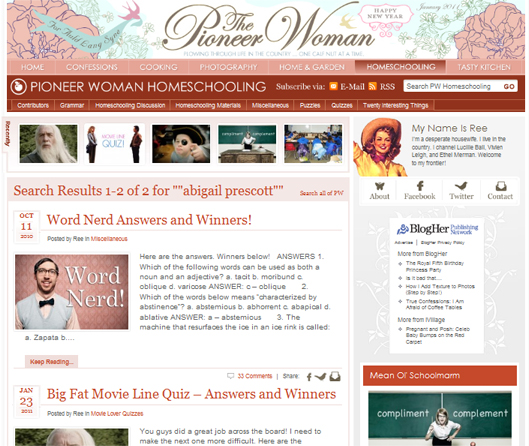
We have a great give-and-take. She gives me an Amazon Giftcard and I take a ridiculously giddy thrill in becoming a bonafide search term on her website.

(Please don’t tell me I’m pathetic. You already know how morose I was about my ill-fated brush with Joni Webb. And this actually came with money attached, so I think I have a right to be coasting on good-feelings for a couple days.)

In October 2010, I managed to eke out a “W” on PW’s Word Nerd Quiz. And got a massive hit of Amazon crack to feed my book/tech addiction.

Then last night, I happened upon PW’s Big Fat Movie Line Quiz. Although it had been open for more than an hour already (her quizzes are usually speed drills and I only won the Word Nerd because I knew every one of the answers without having to look up anything), I gave it a whirl. Because you know how much I adore movies.

And I’ll be darned. More Amazon crack.

Happy Birthday to me!

If I had a job, I’d probably be quitting to play blog sweeps full-time. But even if I never win another thing, I am now “immortalized” on the PW website.

Does it make me a creepy blog stalker if I think that’s kinda cool? As long as I don’t write her and ask for a lock of hair to weave into mine or a calf-nut to pray over or something else weird? Because I promise: I won’t do that.

PW, I swear my admiration is purely un-creepy and nonthreatening. I promise, I’m a very normal person.

Dark, yes. Disturbed, yes.

Surly, lazy, misanthropic, and crass? Okay, fine.

But mostly normal other than those completely harmless flaws.

Normal. I swear.

P.S. Okay, who am I really kidding here anyway?

Darcy Made Bank

In an effort to prove I have not totally fallen off the face of the earth, allow me to indulge in a bit of useless trivia.

Yes, this is random. But this way you know it’s really me posting and not some shameless imposter.

I began reading Jane Austen about ten years ago. I’m not entirely sure why it took me so long to discover her works. I’m just glad I did, eventually, wake up.

One of the things that struck me upon my first reading of Pride & Prejudice was the odd but seemingly universal custom of personal income as a topic of public conversation. My parents raised me to believe discussions of income were strictly private. But, if Jane Austen novels are an accurate indicator, there was no such pretense in Regency Britain.

The opening salvo of Pride & Prejudice is predicated on a young man “of good fortune” — in Bingley’s case, “four or five thousand [pounds] a year.” Each subsequent young man or woman who makes an appearance has his/her fortune brought forward with equal familiarity.

I can see the function of this practice in Regency society, but I can’t help but wonder how the information came to be public property. Was there some sort of racing form for the eligible gentleman and ladies of the day? Can you imagine your income preceding you into every room? Every person you meet already knowing the particulars of your net worth? It’s a little creepy.

But naturally, the focus on finance leads to the question that perforated my enjoyment of Austen novels from the first time I read Pride & Prejudice.

Exactly how rich is Mr. Darcy? What is £10,000 a year worth these days?

Thank goodness for the internet and it’s ability to help satisfy my hunger for random and totally useless knowledge. And yours, too, apparently.

Presuming Pride & Prejudice takes place in 1813, the year in which it was published, Mr. Darcy’s £10,000 a year would be valued at about £520,000 pounds today. Or to us Americanos, a mere $816,296 per year.

Just in case it sounds a little chintzy, keep in mind that this is interest income; Darcy doesn’t have to lift a finger because the $20,407,400 he has salted away does all the heavy lifting.

How did I arrive at these numbers? Completely without any attention to the scientific method, economic theory or statistical precision, I assure you. I just looked up the purchasing power of the Pound Sterling in 1813 and converted it’s contemporary value to dollars. Ergo, these calculations are for entertainment purposes only; there are about four million holes in my methodology. Comparing the purchasing power of assets in 1813 to today is next to impossible because of the massive demographic shifts over the last two hundred years.The Industrial Revolution, the end of slavery, the development of global transportation and communications technologies, derail any real comparison.

For example, a servant in Austen’s time was paid between £10 and £20 a year — about $500 in adjusted dollars. Imagine if you were able to hire an obsequious adult to cook, clean, dress you, answer your door, bring you breakfast in bed and take Mr. Darcy’s hat when he comes for tea. All for $500 a year and one day off a month?

Yes, please. I’ll take four.

Anthropolgie, Austen & Alcott

It is a truth universally acknowledged, that an Oelschlaeger 1 woman 2 in possession of a good library must be in want of a few backup copies.

I’m a re-reader. Sue me. The only thing better than reading a good book the first time is reading it the third time. And the eighth time.

My husband can’t understand how I can read and re-read the same books over and over. Yes, I know how it ends. Yes, I’ve seen the movie. No, I will not put the book down.

Am I the only one who does this? Or, like my husband, do you belong to the “read-toss-repeat” school of literacy? I have no pretensions of superiority over people in the latter group, but in the interest of promoting understanding and tolerance between bibliophiles, allow me an example to illuminate my mindset more thoroughly.

Would you rather: a) have lunch with a total stranger in hopes he or she might become a new friend, or b) sit down for a good two-hour gabfest with a dear old friend who knew you back when you were skinny and stupid and 100% positive that if Joey McIntyre3 ever met you, he’d fall madly in love with you?

I find that a very lopsided debate.

As a result, I have the perennial problem of reading my favorite books until they literally fall apart at the seams. For example, at my current rate of consumption, by the age of eighty, I will have retired eight copies of Gone with the Wind.

Anyway, loyalty to my favorite classics makes me very anxious to find hardback copies that will hold up to repeated use and abuse. And through a fortunate series of events, I was able to make a much-anticipated pilgrimage to the opening of our first Anthropologie Friday before last.

[Before coming to the point, I must say I can now understand see the Anthro attraction. That said, I was slightly disappointed in the lack of furniture and most housewares. But for the awe-inspiring hardware, dishes and a few other finds, the inventory was decidedly apparel-centered. Not that I didn't see clothes I would've happily adopted, but fashion's not exactly my forte. More's the pity for all of humanity.]

One of my favorite finds, however, was Anthropologie’s collection of Penguin Classic hardback books.

The cloth covers are lusciously beautiful.

Complete with an attached bookmark.

They have some of my favorites.

It was all I could do not to buy one. Or five.

I think I would want to buy the Yellow Pages if the cover looked like this.

Twenty dollars is a little rich for a single volume — but I was sorely tempted. Luckily, these editions are also available on Amazon.com at a suitably discounted price.

Am I too old to make out a list for Santa Claus?


  1. Yes, this is my maiden name. Yes, it’s German. Yes, it was hard to learn to spell. Yes, I see an explicating follow-up post in my future…
  2. Specifically my mother and sister: fellow incurable bibliophiles. I can’t vouch for their possible affliction with re-reading syndrome, but they are as loathe as I to voluntarily surrender any book.
  3. Oh, the shame of it. But it was true back in the day. Please don’t stop loving me because of a little thing like this.

Bargain of the Week: Books

In light of my previous post, cue the refrain of Creedence: “Before you accuse me…”

Yes, I am a book hoarder. I tried to get therapy but the support group met at the Public Library.

The only sure-fire cure is … a fire. (God forbid.) In vain, I suffer. And binge.

Books a MillionThis is me, justifying my addiction.

“I only spent six dollars.”

True. Cabbages and Kings and Man-eaters of Tsavo: $1.99 each. Ramona the Brave: 75 cents. Runaway Ralph and Stuart Little: 20 cents each.

“I need new books to read.”

Only about 50% true. I’ve read all three of the kids books many times. I even have a copy of Stuart Little on my shelf already. (But who doesn’t need an extra Stuart Little lying around? For 20 cents? Come on. Tell me you’re not that hard-hearted.)

“I buy books for my kids.”

Lie. Total and complete lie. Yes, Griffin is approaching chapter book readiness but I bought the Cleary books because I wanted to read them. (Again.)

As far as Cabbages and Kings and Man-eaters of Tsavo: well, I bought them because I just like old books. I like the shiny-dusty contrast of embossed gold on worn book covers. I like deckle-edged pages and bright illustration plates peeking through tissue leaves. I like the penciled-in prices and formal insignia of the original booksellers. I like the carefully inked personalization of the original owner. I like the somber weight a stack of old books gives to a shelf of more frivolous decor.

It helps if I want to read them, of course. I had to give this one a try.

Man-eaters of TsavoWilliam Goldman [INSERT: an awed hush falls over the screenwriters] used this book as the basis for a film which fell flat at the box office. But, hey, I enjoyed it and that’s all that matters.

In the interests of full disclosure, I balked at the price. For $1.99, I could have gotten ten copies of Stuart Little after all. But I couldn’t leave the Old Gentleman to rot on an ignominious shelf of a derelict thrift store until his binding crumbled with despair. It’s a disease, people.

Title Page

The First Kill

End PaperI’m not sorry. And I don’t intend to change.

I didn’t start wondering if this book was valuable until after I got home. This may be the only time in history that I’ve actually made money (strictly in theory, of course) while spending money.

I have no plans to actually sell this book but I find some small satisfaction in the knowledge it retained value over the last 80 years better than, say, your average Beanie Baby.

It gives me a little hope for humanity yet.

Related Posts with Thumbnails