Tag Archives: random

Topsy Turvy Freaky

It’s weird the things that can frighten me now that I’m an adult.

I’m not talking about real horrors that could rob me of my sheltered life: terminal illness, family tragedies, natural disasters, Chinese organ thieves. That stuff, I can handle.

I’m not even freaked by “usual” weird stuff.

Clowns, for example. Maybe it’s due to my own brush with “clown culture” — more about that another day, perhaps — but I actually like clowns.

We used to watch Bozo the Clown on WGN every morning. (The Grand Prize Game was like Who Wants to be a Millionaire? for kids. Greed and avarice served with a side of Archway Cookies.)

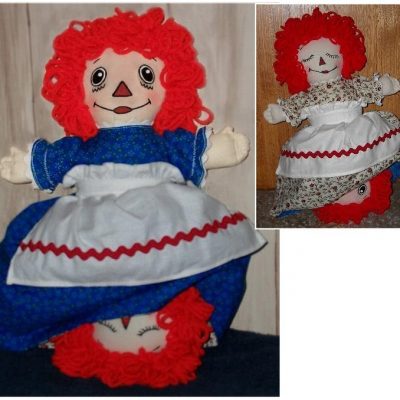
Topsy Turvy dolls, however? Ugh.

Ignoring the obvious racial connotations of the above doll for a moment, can you understand the creepy?

[Shiver.]

The church I grew up in had a couple of topsy turvy dolls in the nursery. As I recall, they were not racially, er, “mixed,” but brunette on one side and blond on the other. I also remember I liked playing with them. Or at least making sure that shameful blond side was decently hidden.  (Yes, I harbor latent anti-blond resentments. Sue me.)

Somehow, over the last thirty years, I’ve come to detest these innocent dollies. I’m not sure why. Maybe it’s the expanded understanding of human anatomy that comes with adulthood. Or one too many conjoined twins documentaries on TLC.

Whatever. Topsy turvy dolls give me the willies.

Lest you misunderstand, I am not an advocate on anatomically-correct dolls for children. I think Barbie is just swell as she is — hinges, smooth mammaries and all.

But there is something about the-legs-become-the-arms-and-the-arms-become-the-legs-and-suddenly-there’s-another-head-down-there-where-no-head-should-ever-be-on-a-doll that just plain creeps me out.

I’m sure some people find it cute and endearing.

And they’re wrong. Gravely wrong.

Something about it’s just indecent. And a little predatory. Like Aliens or something.

“I have triumphed over you. Now I will absorb you and assimilate your lifeforce…”

The only time this kind of scene is appropriate is childbirth. And I still don’t want to see it. That’s why I pay an obstetrician.

But this is a doll. A doll. For little girls.

Why is there another head? Why????


Andy? What are you doing down there?

I think I’m going to throw up.

Darcy Made Bank

In an effort to prove I have not totally fallen off the face of the earth, allow me to indulge in a bit of useless trivia.

Yes, this is random. But this way you know it’s really me posting and not some shameless imposter.

I began reading Jane Austen about ten years ago. I’m not entirely sure why it took me so long to discover her works. I’m just glad I did, eventually, wake up.

One of the things that struck me upon my first reading of Pride & Prejudice was the odd but seemingly universal custom of personal income as a topic of public conversation. My parents raised me to believe discussions of income were strictly private. But, if Jane Austen novels are an accurate indicator, there was no such pretense in Regency Britain.

The opening salvo of Pride & Prejudice is predicated on a young man “of good fortune” — in Bingley’s case, “four or five thousand [pounds] a year.” Each subsequent young man or woman who makes an appearance has his/her fortune brought forward with equal familiarity.

I can see the function of this practice in Regency society, but I can’t help but wonder how the information came to be public property. Was there some sort of racing form for the eligible gentleman and ladies of the day? Can you imagine your income preceding you into every room? Every person you meet already knowing the particulars of your net worth? It’s a little creepy.

But naturally, the focus on finance leads to the question that perforated my enjoyment of Austen novels from the first time I read Pride & Prejudice.

Exactly how rich is Mr. Darcy? What is £10,000 a year worth these days?

Thank goodness for the internet and it’s ability to help satisfy my hunger for random and totally useless knowledge. And yours, too, apparently.

Presuming Pride & Prejudice takes place in 1813, the year in which it was published, Mr. Darcy’s £10,000 a year would be valued at about £520,000 pounds today. Or to us Americanos, a mere $816,296 per year.

Just in case it sounds a little chintzy, keep in mind that this is interest income; Darcy doesn’t have to lift a finger because the $20,407,400 he has salted away does all the heavy lifting.

How did I arrive at these numbers? Completely without any attention to the scientific method, economic theory or statistical precision, I assure you. I just looked up the purchasing power of the Pound Sterling in 1813 and converted it’s contemporary value to dollars. Ergo, these calculations are for entertainment purposes only; there are about four million holes in my methodology. Comparing the purchasing power of assets in 1813 to today is next to impossible because of the massive demographic shifts over the last two hundred years.The Industrial Revolution, the end of slavery, the development of global transportation and communications technologies, derail any real comparison.

For example, a servant in Austen’s time was paid between £10 and £20 a year — about $500 in adjusted dollars. Imagine if you were able to hire an obsequious adult to cook, clean, dress you, answer your door, bring you breakfast in bed and take Mr. Darcy’s hat when he comes for tea. All for $500 a year and one day off a month?

Yes, please. I’ll take four.

Honey or Vinegar

You catch more flies with honey than with vinegar. Or so the saying goes.

I played eyewitness to someone else’s “vinegar moment” today. And the response of the flies.

After naptime this afternoon, I piled the boys in the car for a quick run to a local specialty retailer (which shall remain nameless) to stock up on a few supplies.

It was after 4 PM — that magic hour between school dismissal and the end of the workday when everyone else is trying to cram in their last-minute errands, too— so I was braced for delay. Patience is not one of my core competencies, but after all, life is waiting and I’m learning acceptance is key.

Plus, my five-year-old is going through a very “anti-wait” phase, so I’m trying to set a good example by not being in such an all-fired rush all the time.

As expected, the checkout lines were long. (At least my mental preparation wasn’t for naught.) But apparently, not everyone was prepared.

To be fair, I don’t know how long the woman in front of me had been standing in line. Nor do I know what was the source of the delay. But whatever the time lapse, it was evidently far too long. I was busy enough trying to distract the boys from the candy rack our place in line had unluckily designated us to stand beside that I didn’t really tune into her increasing complaints, but I was vaguely aware that her companion or the poor person who called her on her cell phone were getting an earful.

After a few minutes, a CSM (Customer Service Manager) passed by, giving the woman in front me an opportunity to express her displeasure and “encourage” the CSM to ring her up on another register. No dice. The crabby customer’s turn at the checkout eventually came, whereupon the cashier gave her some policy excuse, explaining why the CSM couldn’t open another register — which didn’t seem to deflate her outrage one whit. The woman paid and left in a huff.

I don’t think she was more than two inches out the door when the CSM asked me if I was ready to check out and guided me over to a newly-opened register. It was as if the employees were waiting for Miss Crabby Pants to leave before making sure every other customer was checked out as quickly as possible.

I thought it was pretty funny until I started wondering if I’ve ever been such a raging lunatic that a Customer Service Manager will go out of their way to offer less service. Hmmmm. I’m not one for such moments in public — I save all my vinegar for those I love the most! — but I feel myself becoming more inclined as I get older.

Anyway, it was a good reminder of the value of a “sweet temper.”

I know I could certainly use a little honey in my crabby old soul.

Happy weekend,

As Seen On TV

Admittedly, this post is random. But I have no less than 20 posts in my draft file right now — all in various stages of completion — and not the time to finish any one of them.

So I thought I’d just mention. The Ped Egg does actually work.

This is not a particularly speedy tool by any means, but if you don’t mind keeping your hands busy while you watch TV, you can knock it out.

You’ll have to take my word for it, though. I have no “before and after” pictures.

That would just be gross.

Not that there aren’t plenty of “before and after” photos on the internet.

I guess some people are into “gross.”

Abigail

Related Posts with Thumbnails