Monthly Archives: February 2010

Some Enchanted Evening

You may see a stranger.

You may see a stranger, across a crowded room…

I had such an encounter yesterday. The longing. The excitement. The bargain.

Be still my heart.

At first, I thought I’d paint the whole cabinet white, but after making friends with it, I’m not sure I can. I may try replacing the back with a piece of white beadboard and see if I can forgive myself.  If I remain unbeset by conscience after such a breach of civility, this little darling may have a date with a can of paint.

I also found a set of milk-glass octagonal mugs and this funky, medieval-looking sconce.

Just funny little things but they get my creative energies peaking. I start dreaming of the day I can put out a few knickknacks without fearing that my sons will turn a funky sconce into a halberd and try to impale one another.

But that’s my life.

And somehow you know, you know even then.

That somewhere you’ll see her, again and again…

Words on the Bus Go Round and Round

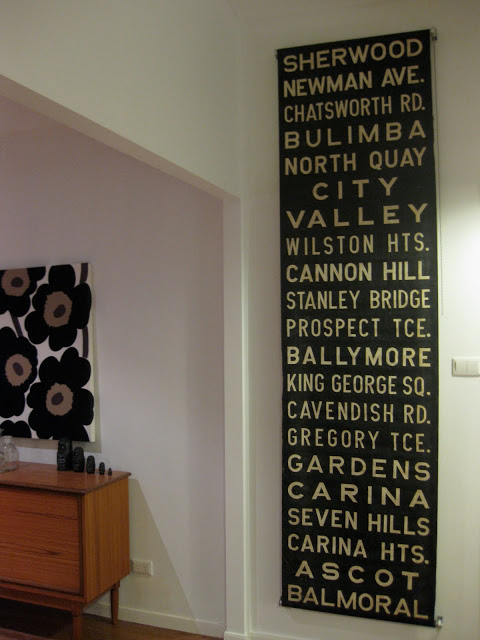
As of late, I’ve been very intrigued by vintage roll signs from old buses and trains. I’m not sure if it’s the simplicity of the white-on-black or the use of graphic text as art, but I love them.

Photo: printdolls.com.au

Thanks to the wonders of mass transit, these signs are plentiful in the UK (though usually called “destination blinds”). They’re also a bit…er, pricey. I don’t really know what the pound/dollar conversion rate is right now, but I’m thinking £125 is expensive.

Actually, 125 dollars is beyond my present means.

We’d probably have to be talking pesos, or bahts, or rupees before “125″ starts to sound reasonable for something to hang on my wall.

Acquisitiveness being the mother of invention that it is, I started playing and came up with my own version.

Sign

Rather than copy the bus route for a place I’ve never been, I used each of the streets I’ve lived on over the last 33 years. A little kitschy, maybe, but I love the way it turned out.

It’s still slightly unfinished. I used a cheapo canvas that was only of medium smoothness, so there was more bleeding that I anticipated. I need to decide if I want to go back and fill in the bleeds or leave it as is for that vintage [sloppy?] appeal.

I haven’t made up my mind yet. Opinions are welcome.

I may also hit it with a little Ralph Lauren smoke glaze so it isn’t so brilliantly white. I’m stalling though. I don’t really want to spend $30 for a gallon of glaze at the moment. There’s no rush.

But I predict more of these signs in my future… Luckily, they’re cheap.

A steal at a mere 232 bahts.

Character Intros and How To Screw Them Up

I haven’t very much writing lately — beyond transcribing the little voices in my head. However, a couple of movies I watched this week elevated my level of personal sanctimony to such a degree as to allow me to criticize the work of others.

Actual professionals have weighed in on the finer points of introducing a character, John August not the least among them. If there’s anything I can add to this well-trodden road, it’s only the annoyance of an audience member who’d rather see a bad movie than a good-movie-gone-bad. Stupid mistakes, especially from professionals who make a living making films, are another example of complacency bred by success.

Exhibit A: The Holiday.

I won’t turn this into a full-fledged review, but suffice it to say that there are three reasons to watch this movie.

  1. Kate Winslet.
  2. Eli Wallach.
  3. The Houses. [Oh, The Houses. Oops. I think I drooled on my keyboard.]

No, Gwyneth, I will not add Jude Law on the list. He’s practically scenery in this flick. Very pretty scenery. In his defense, “pretty scenery” makes him slightly less offensive than the hopelessly miscast Cameron Diaz. (When she’s onscreen, I just close my eyes and mentally replace her with Sandra Bullock.)

Back to the issue of character intros, the film opens with a montage of four short scenes featuring the two main characters and their soon-to-be lovers in turn, narrated by the lovely Kate Winslet as sad sack Iris Simpkins. Jude Law, playing Iris’ brother Graham, gets nothing but a “strangers in the night, exchanging glances” moment in a pub with a random female patron as the narration hints at a one-night stand.

The montage concludes at Iris’ workplace. We get a few serviceable minutes with Iris and Jasper, the wolf-in-creep’s-clothing ex-boyfriend, before cutting to the office Christmas party scene in which Iris confides in a nameless female colleague over a glass of wine, explaining her history with Jasper and making it clear she’s still in love with him.

Structurally-speaking, we need the exposition: moments later, Jasper announces he’s engaged to the woman for whom he dumped Iris in the first place. The audience needs to sympathize with Iris’ heartbreak. We have to see how Jasper leads her around by the nose, despite his intentions with another woman. Winslet has exactly the light touch needed to engage us in Iris’ sorrow without presuming upon our sympathies.

But why does Nancy Myers have to trot out arguably the most boring and cliched stock character on film — The Snarky Best Friend — to be Iris’ confidant?

Really?

Just because she has a posh accent, it doesn’t mean we care. We never learn this woman’s name. We never see her again in the entire movie. Was the actress a friend of the producers? Did she need the paycheck? Was she just that many points away from SAG membership?

Iris’ confidant — and I don’t think I’m any kind of a genius here — should have been Graham. Duh. Her brother. It’s not rocket science.

Imagine: Graham drops by her office, walks in on her tête-à-tête with Jasper and decided to flex his big brother disapproval muscles with a couple of acid comments at Jasper’s expense. Jasper exits. Insert Iris’ exposition here, except to Graham instead of Posh Snarky. Graham comforts her and urges her to move on with her life — “You’re too good for him, Iris,” etc. — before he gets a call from his daughter and departs.

Not only would this have given Iris her much-needed confidant but it would have introduced Graham much earlier and actually given two exceptional actors a real scene to play together, instead of the hackneyed “life is beautiful and everybody wins” denouement at the end of the film.

More importantly, this would have made for a much more sympathetic introduction for Graham and given us a snowball’s chance to actually like him. On the contrary, Graham doesn’t appear in the movie (aside from his pub scene “introduction”) for at least 20 minutes, when he shows up at Iris’ cottage in the middle of the night, drunk and threatening to urinate on her doorstep. Upon discovering that Iris has exchanged homes with an American stranger — and said American stranger looks exactly like Cameron Diaz — he does what any self-respecting, widowed British book editor with two young daughters would do: he beds her that very night.

We eventually find out the extenuating circumstances of Graham’s antisocial behavior, but it’s too late — Myers has already lost us. She’s drawn Graham as a promiscuous, self-absorbed, alcoholic absentee-father so out of touch with his heartbroken sister that he’s shocked to learn she won’t be able to lodge his drunken arse on her sofa because she’s left the bloody country.

Oh, and he cries at the drop of a hat.

Only a character as neurotic and annoying as Diaz’s Amanda would deserve such an emotional homunculus.

[And, by the way, promiscuity can be a very effective character point, but on a widower with young children whom we're supposed to like, it just reads false to me. Who's watching his kids while he's out sowing his widowed oats?]

And then there’s Exhibit B: Public Enemies.

We watched this over the weekend. All in all, a nice bit of acting by Johnny Depp and Christian Bale. Missing, of course, much character development beyond some brooding glances and a meaningful blink or two. But there’s one little thing I cannot get past.

At some point in the first act of the film, Christian Bale’s Special Agent Mevin Purvis — the man tasked with arresting Public Enemy Number One, John Dillinger (Johnny Depp) — realizes that his team of agents in the newly-created FBI are too green to be effective in apprehending the crooks. Purvis goes to his boss, J. Edgar Hoover, and asks for permission to bring in Agents Winstead and Campbell from out yonder in Oklahoma and Texas — the men who took down Bonnie and Clyde and Machine Gun Kelly and have the experience needed to help Purvis take down Dillinger.

And Hoover (played spot-on by Billy Crudup) says: “Yes.”

Cool.

And thirty minutes go by.

Joined by a chorus line of ineptitude masquerading as FBI agents, Purvis launches a series of ill-starred forays to stop Dillinger. In the midst of this catalog of abuse of power, I finally turned to my husband and asked: “Where are the guys from Oklahoma and Texas?”

Eventually, they appeared. And not on a slow boat from China, which I assumed would be the only legitimate excuse for their trip having taken such an unconscionable length of time. No, their train pulled into Chicago’s Union Station and these good ol’ boys hopped off to greet Purvis as pretty as you please.

I kept waiting for Purvis to provoke a shootout on the stairs.

PURVIS:    Don’t any of you damn cowboys own a watch?!?!? [Bang, bang, bang.]

But no. No mention of delay. No urgency. Just: “Welcome to Chicago.”

Michael Mann does a better job of balancing the storyline of concurrent heroes and villains than just about any director in Hollywood. The Last of the Mohicans? Heat? Even The Insider.

Urgency. Tension. High stakes. He’s a master.

That’s why I just can’t figure out what happened here. Public Enemies should have been old home week.

[Scratching head.]

At the risk of buying in to our instant gratification culture, let me say: Time should serve the needs of the Story.

If the Story doesn’t call for the Red River boys until Act Two — and there’s no Story or Character significance to the delay, i.e. Hoover proving he’s a jerk, a hurricane is sweeping the Midwest, The Lexington Hotel was all booked up, Dillinger waylaid them on the trip, etc. — don’t have a character ask for them until just before the moment the Story needs them to appear.

This could have been an easy fix in the editing room and it’s not a major story point. But it’s annoying. And distracting. If it takes the audience out of the Story and back into the real world to wonder how slow a train could possibly be in 1933, it’s bad for the film.

At least that’s what the little voices in my head seem to think.

Wishful Thinking

Like so many others, I’ve had my own private yearnings for a set of Tolix tabouret stools.

Tolix Stool

But golly. The Conran Shop wants $325 each.

I need four.

Let’s see: $325 x 4 = There is No Way in God’s Green Earth.

Trust Robert Redford to fight for the little people. Tolix stools can be had from the Sundance Catalog for a mere $245.

Luckily, I shared my private yearnings with a friend. Someone I could trust. Someone with whom I share both an aesthetic and a modest budget.

Days later, she sent me a link to Overstock.com, and I flipped. And then I begged. “Please, honey. Pleeeeeese…”

Bargain stools plus $2.95 shipping? Get out. [Insert shove, Elaine Benes-style.]

Incidentally, should you ever need a properly-sized box in which to ship a 2- to 4-year-old child to the furthest reaches of the planet, I highly recommend ordering these stools. Although I suspect shipping to the furthest reaches is more than $2.95. Not that I would ever even consider such a thing. At least not long enough to find the packing tape.

Besides, they love the stools.

Granted, these stools are not the authentic Tolix, galvanized steel version I would have preferred. But I guess having very nice, powder-coated knock-offs and keeping both my kidneys is a reasonable compromise.

Naturally, adding something I love makes me start looking around my house and noticing all of the things I un-love. Yellow kitchen cabinets, for example. The gray tile backsplash. And the bare spots in my living room.

When I had no children — and an actual income — I bought a fantastic antique trunk to serve as a coffee table. The dealer told me it was from Nantucket and over 100 years old. (Not sure I believed her but I loved it, so why quibble?)

As my sons have gotten older, I’ve begun to realize how very impractical this piece of furniture, once purely decorative, has become. At least if I want to keep it in one piece.

My kids think “antique” is a synonym for “jungle gym.” It’s a stage. It’s a hideout. It’s a launch platform for Intercontinental Ballistic Missiles.

It’s one false move away from becoming a pile of expensive toothpicks.

Sometimes I wonder why I have closets filled with assorted objets d’art instead of putting them on display where they can be appreciated. I might even take out a few of my favorite treasures and imagine where I’ll hang them. And then I hear a series of bangs and a muffled crash and I come to my senses. I’m not bitter. I’m just resigned.

This weekend, the boys finally ripped a hinge out of the trunk and Scott moved it into the bedroom. And now I have a hole.

I kind of like the idea of a large, square coffee table. Maybe even a huge, tufted ottoman with nailhead trim.

Only time will tell how it gets filled. Not to mention this one.

Two smallish upholstered stools or low chairs? Or maybe one long table or buffet to replace the current one?

Of course, whatever I find, it must be cheap. And durable. “Kid-tested, Chernobyl-approved” kind of durable. Which is another thing I love about my knock-off stools. They’re heavy-duty metal. How much damage can two small boys possibly do?

Bang, bang, bang.

Crash.

I must go.

I think I hear my sons trying to stab each other with stool legs.

An Experiment

Sit down. I have something to confess.

[Deep breath.]

I am not a fashionista.

I know you’re shocked and I’m very sorry to disappoint. But I’m just trying to honest here. I hope you can come to accept the real me.

Now, I like to look cute just as much as the next gal. It’s just not usually within my budget or attention span. But any time I have “An Event” on the horizon, I try to get a leetle motivated to break out of dumpy-frumpy, if only for the one night. Then I can go back to my slob roots with a clear conscience.

I’m attending the Junior League’s Decadence fundraiser this Saturday night. The theme — “Diamonds & Denim” — is right up my alley, but I’ve had one nagging question.  (Men, you have my permission to skip the rest of this blog.)

“What kind of handbag does one carry to such an Event?”

I have a serviceable “evening bag.” Being that it’s in the black-sequins-and-beading family, however, it just seems wrong for this event. And I can’t bring my everyday purse, for crying out loud. The elevator has a weight limit.

So. I sew.

I wanted something small and “discreet” — no, this is not a concealed carry purse — chic but still casual enough to suit jeans. Cell phone, ID, lipstick.

Clutch Front

Clutch Back

Clutch Inside

Clutch Inside 2

Oh, by the way, it’s a necktie. Or was.

It’s intentionally asymmetrical and somewhat sculptural. I’ve seen lots of hobo bags made from neckties but I was aiming elsewhere.

Do you hate it? Am I crazy? Is there a Clinton-and-Stacy intervention in my future?

Related Posts with Thumbnails